


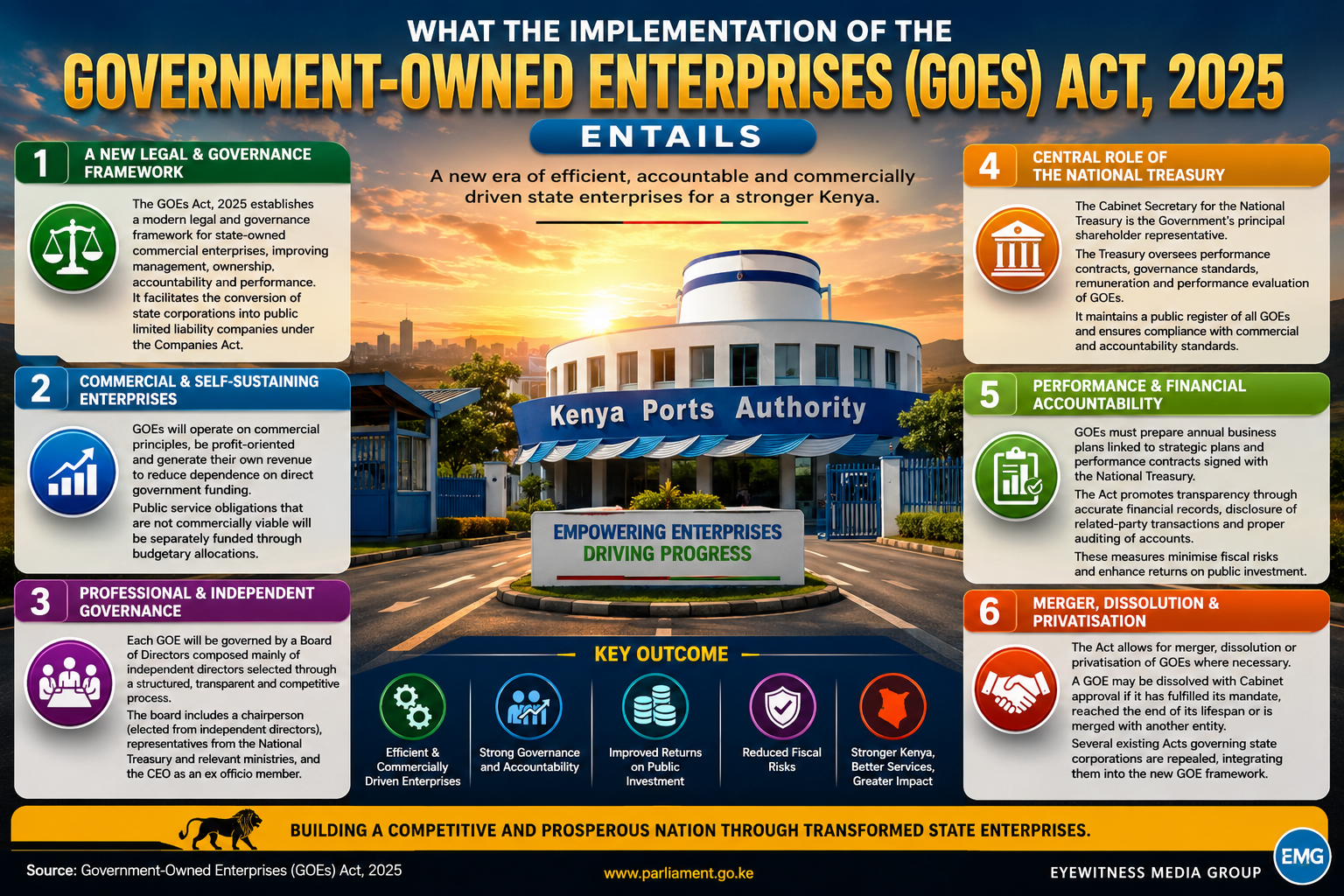
INFOGRAPHIC/EYEWITNESS MEDIA GROUP
By PATRICK MAYOYO
In a move that could fundamentally reshape Kenya’s state corporations, the Government has begun implementing provisions of the Government-Owned Enterprises (GOEs) Act, 2025.
The National Treasury has advertised vacancies for independent directors in 39 parastatals, signalling a major departure from the traditional process of appointing directors to state corporations. Previously, Cabinet Secretaries appointed directors without publicly advertising the positions, while chairpersons of the same entities were appointed directly by the President.
The shift forms part of the Government’s broader plan to implement the Government-Owned Enterprises (GOEs) Act, 2025, which President William Ruto assented to and which came into force in December 2025.
The Act provides for the dissolution of certain state corporations and their reincorporation as limited liability companies under the Companies Act. Under the new framework, commercial state entities are expected to transition into profit-oriented public limited companies, with the National Treasury serving as the principal shareholder on behalf of the Government.
One of the key provisions of the Act is the restructuring of government-owned entities into profit-oriented and self-sustaining commercial enterprises. Under the law, GOEs are expected to operate on commercial principles, generate their own revenue, and reduce dependence on direct government funding. However, where the Government assigns public service obligations that are not commercially viable, such activities must be separately funded through budgetary allocations.
It is against this backdrop that the Treasury advertised vacancies for independent directors across 39 parastatals, covering both profit-making and loss-making entities.
In a notice dated 13 May, the Treasury stated that the recruitment process follows reforms approved by the Cabinet in November 2023, which officially took effect on 2 December 2025, replacing previous governance structures and legal frameworks governing state-owned enterprises.
“The National Treasury intends to fill vacant positions on the Boards of Directors of Government-Owned Entities in line with Section 10 of the Government-Owned Enterprises Act, 2025,” the Treasury stated.
The announcement has caused anxiety among directors serving in various state corporations following the advertisement of their positions. Among the leading parastatals expected to undergo board changes are Kenya Ports Authority (KPA), Kenya Railways Corporation, Kenya Power and Lighting Company, Kenya Electricity Generating Company (KenGen), Kenya Electricity Transmission Company (KETRACO), Geothermal Development Company (GDC), National Oil Corporation of Kenya (NOCK), Agricultural Development Corporation, and Agricultural Finance Corporation.

Kenya Ports Authority managing director Captain William Ruto, his parastatal is among those ear-marked for immediate reforms. PHOTO/KPA.
Other entities set to receive new directors include Kenya Development Corporation (KDC), Kenya National Trading Corporation, Kenya Seed Company, Kenya Veterinary Vaccines Production Institute, National Cereals and Produce Board (NCPB), Pyrethrum Processing Company of Kenya Ltd, Nyayo Tea Zones Development Corporation, New Kenya Co-operative Creameries Limited, New Kenya Planters Co-operative Union PLC, and the National Mining Corporation.
The Kenyan Government’s decision to implement the GOEs Act marks a significant shift in the governance and management of state corporations. By converting selected state-owned enterprises into limited liability companies and restructuring their boards, the Government hopes to improve operational efficiency, strengthen financial performance, and attract private sector participation.
While the reforms present opportunities for economic growth, they also raise concerns that will require careful management to protect public interests.
One of the immediate consequences of implementing the GOEs Act is the restructuring of governance systems within state corporations. Boards of directors in 39 parastatals, including KPA, Kenya Railways Corporation, Kenya Power, and KenGen, are expected to be reconstituted with independent directors.
The Act introduces a formal recruitment and selection process intended to ensure that board members possess the necessary expertise in finance, corporate governance, auditing, law, and operational management. The reforms are expected to improve oversight, strengthen accountability, and enhance strategic decision-making, particularly in institutions that have previously struggled with inefficiency and poor governance.
From an operational perspective, converting state corporations into commercially driven entities is expected to encourage greater efficiency and financial discipline. Institutions such as KPA are likely to transition from purely state-controlled models into liability firms where private sector players assume operational responsibilities and risks, while the Government retains ownership.
The new arrangement is expected to reduce bureaucratic inefficiencies, streamline port operations, and improve service delivery, especially within the maritime sector, which remains critical to Kenya’s import-dependent economy.
Economically, the reforms could attract substantial private investment, both local and foreign. The planned privatisation of Lamu Port and strategic berths at the Port of Mombasa is expected to inject fresh capital, modern technology, and specialised management expertise into Kenya’s infrastructure sector.
Improved efficiency at the ports could strengthen Kenya’s position as a regional trade hub serving landlocked countries such as Uganda, South Sudan, and Ethiopia. In addition, better-performing state corporations could generate increased revenues for the Treasury, allowing the Government to redirect resources towards priority sectors such as healthcare, education, and infrastructure development.
However, the reforms also carry significant risks. Restructuring state corporations could lead to job losses and trigger social and political tensions if not managed carefully. Analysts also warn that the success of the reforms will depend heavily on the Government’s ability to maintain strong regulatory oversight while delegating operational responsibilities to private entities.
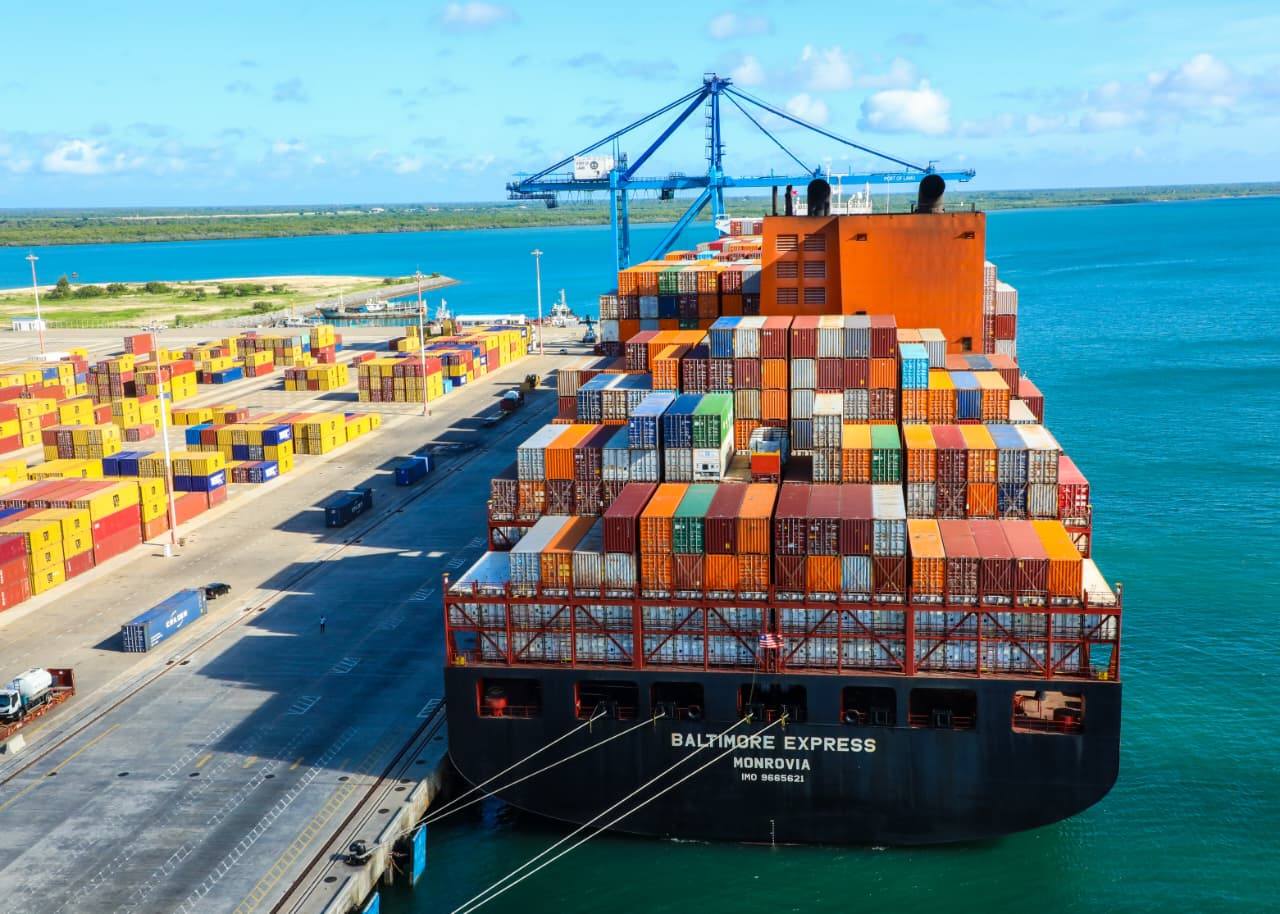
A ship at Lamu Port. PHOTO/KPA.
Without effective governance structures, critics argue that commercial interests could override public accountability and compromise service delivery.
The ongoing restructuring is expected to have a particularly significant impact on Kenya’s maritime sector. The Government plans to dissolve the Kenya Ports Authority and replace it with a liability firm as part of a broader strategy to privatise Lamu Port and two strategic berths at the Port of Mombasa.
Officials argue that the reforms are intended to improve efficiency, attract investment, and reduce the financial burden on the State.
Under the proposed arrangement, private sector players would take over the management and operational risks traditionally borne by KPA. Unlike the current structure, where the authority oversees infrastructure development, port operations, and regulatory functions, the new model would allow the Government to retain ownership of the ports while outsourcing day-to-day management to private operators.
“The transformation of KPA into a liability firm is intended to unlock investment, improve operational efficiency, and make our ports globally competitive,” said a senior official at the Ministry of Transport. “We aim to reduce bureaucratic bottlenecks that have historically slowed down port operations.”
Lamu Port, a flagship project under the Lamu Port-South Sudan-Ethiopia Transport (LAPSSET) Corridor, has long been viewed as a transformative project for Kenya and the wider East African region. However, delays in construction and operations, coupled with high capital requirements, have slowed the project’s full potential.
The Government believes privatisation could bring in the expertise and financial resources needed to accelerate development while improving cargo handling and logistics management.
Similarly, the Government is considering the privatisation of two strategic berths at the Port of Mombasa, East Africa’s largest port, which handles more than 99 per cent of Kenya’s imports and exports. The berths are central to container traffic and regional trade, and private management is expected to improve throughput, reduce congestion, and shorten vessel turnaround times.
The transition from KPA into a liability company aligns with Kenya’s broader economic reforms aimed at reducing direct state involvement in commercial enterprises.
Economic analysts argue that privatisation could free up billions of shillings in public funds that could be redirected towards essential sectors such as healthcare, education, and infrastructure development. However, concerns remain over job security for KPA employees and the Government’s ability to maintain effective oversight under the new structure.

Kenya Railways is another parastatal set to undergo major restructuring. PHOTO/UGC.
“Privatisation can bring efficiency and investment, but it must be accompanied by strong regulatory frameworks to protect public interest and ensure fair competition,” said an economist specialising in transport infrastructure.
The restructuring of Kenya’s ports comes at a time when East Africa is experiencing rising maritime traffic driven by expanding trade between Africa, Europe, and Asia. Both Mombasa and Lamu ports are strategically positioned to serve as regional trade gateways for landlocked countries such as Uganda, South Sudan, and Ethiopia.
Improving operational efficiency through private sector participation could significantly reshape regional trade dynamics. Although the Government has not announced a definitive timeline for the dissolution of KPA or the completion of the privatisation process, stakeholders expect formal proposals and tender documents to be released in the coming months.
If successfully implemented, the reforms could mark a major turning point in Kenya’s maritime sector and position the country as a leading logistics and trade hub in East Africa. As Kenya embarks on this ambitious transformation, the coming years will test the delicate balance between public oversight, private sector efficiency, and national economic interests.
The Treasury notice stated that all applications for the independent director positions must be submitted no later than 5:00 p.m. on Friday, 26 May 2026. According to the notice, the GOEs Act, 2025, establishes a new governance framework for boards of state-owned enterprises.
“Pursuant to Section 17 of the Act, an independent director shall serve for a term of three years, renewable once, subject to satisfactory performance,” the notice stated.
The Treasury further noted that, under Section 10 of the Act, each GOE board will comprise a chairperson elected from among the independent directors, six independent directors nominated through a Search and Selection Panel by the Cabinet Secretary, two public officers representing the National Treasury and the State Department for Investment, and the Chief Executive Officer, who will serve as an ex officio member.
Applicants are required to meet strict qualifications, including high integrity, demonstrated experience in finance, accounting, auditing, governance, law, or related fields, at least 10 years of professional experience, and a minimum of five years in leadership positions. Applicants must also satisfy the requirements of Chapter Six of the Constitution on leadership and integrity.
“A person is not qualified to be appointed as an independent director of a GOE Board if that person fails to meet the conditions stated in Section 21 and Section 17(2) of the GOEs Act, 2025,” the Treasury stated.
The implementation of the GOEs Act represents one of the Government’s boldest attempts to modernise Kenya’s state corporations and reduce inefficiencies within the public sector. By professionalising governance structures and encouraging private sector participation, the reforms have the potential to improve operational performance, attract investment, and strengthen Kenya’s role in regional trade.
However, the success of the reforms will ultimately depend on the Government’s ability to balance commercial interests with public accountability, protect workers from unfair displacement, and ensure that strategic national assets remain aligned with the country’s long-term economic interests.
If effectively managed, the reforms could usher in a new era of efficiency, competitiveness, and fiscal discipline across Kenya’s public sector.