



In 45 countries, online video now surpasses broadcast television as a source of news.
By TECH CORRESPONDENT
Trust in news has fallen to its lowest level globally since records began in 2015, according to the latest Reuters Institute for the Study of Journalism Digital News Report 2026 , which paints a picture of a rapidly shifting and increasingly fragmented global information landscape.
The annual survey, based on responses from almost 100,000 people across 48 markets, finds audiences worldwide reacting with growing unease to political, economic and technological turbulence, as long-standing assumptions about the international order are increasingly questioned. Against this backdrop, the report concludes that trust in news has dropped to 37 percent globally, its lowest level in over a decade.
The findings, published in the Digital News Report 2026, highlight a media environment being reshaped by the rise of social platforms, artificial intelligence (AI) tools and video-led consumption, alongside declining engagement with traditional news outlets.
For the first time, the report finds that social media and video networks are the most widely used gateways to online news globally, used by 54 percent of respondents. This edges ahead of news organisations’ own websites and apps, which stand at 51 percent.
The shift is described as part of a broader transformation in how audiences consume news, with video-led platforms such as YouTube, Instagram and TikTok playing an increasingly central role in daily information diets.
The report also highlights the rapid but still early-stage rise of artificial intelligence in news consumption. Around 10 percent of respondents now use AI chatbots for news, up from 7 percent last year, with uptake highest among younger audiences.
While still relatively limited, users say they value the ability to ask follow-up questions and gain deeper explanations, signalling what the report calls a “new frontier in intermediated news consumption”.
Online news video has now reached a majority audience across all 48 markets surveyed, with 77 percent of people consuming it weekly. In 45 countries, online video now surpasses broadcast television as a source of news.
However, most of this growth is taking place on third-party platforms rather than news organisations’ own websites, which saw a 5 percentage point decline in video consumption over the past year.
The report finds 27 percent of respondents now access news from individual creators or influencers, while 46 percent consume news from creators more broadly. Although often viewed as more entertaining and relatable, creators are still generally seen as less trustworthy and less impartial than traditional news brands.
Despite their rise, most users of creator content continue to access traditional journalism alongside it, rather than replacing it entirely.
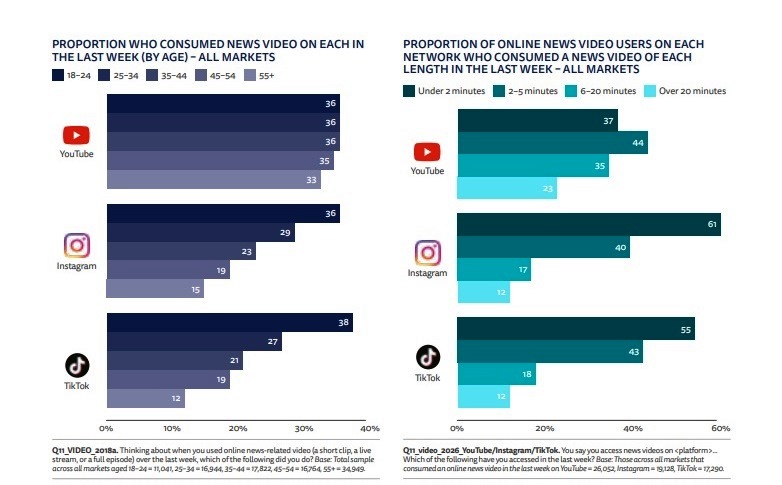
INFOGRAPHIC/REUTERS INSTITUTE.
Public interest in news is also declining, with a 13 percentage point fall since 2021 in those describing themselves as highly interested. A quarter of respondents are now considered “casual or passive” news users, engaging only sporadically.
At the same time, concerns about misinformation have risen, with 62 percent of respondents saying they are worried about fake news.
Trust in news has fallen in 29 of the 48 markets surveyed, with sharp declines in several countries including the United States, where just 25% of people say they trust news most of the time.
The report suggests the shift towards social media, video platforms and AI chatbots, sources generally considered less trustworthy than legacy media, is contributing to the overall decline.
Despite this, support for impartial journalism remains strong, with nearly half of respondents still preferring news that does not take sides.
The findings point to growing challenges for news organisations, including weakening direct audience relationships and stagnating subscription growth, with just 17 percent of people in surveyed countries paying for online news.
The report concludes that while journalism remains widely valued, the global news ecosystem is becoming harder to monetise, less central to daily life, and increasingly shaped by platforms outside traditional media control.
Authored by a team including Jim Egan, Craig T. Robertson, Amy Ross Arguedas, Nic Newman, Rasmus Kleis Nielsen, Mitali Mukherjee and Richard Fletcher, the report warns that the pace of technological and societal change is accelerating, and with it, pressure on trust in news institutions worldwide.