

Sea-level rise along African coasts from 1999 to 2025 exceeds the global average of 3.6 mm per year in several regions. PHOTO/WMO.
By PATRICK MAYOYO
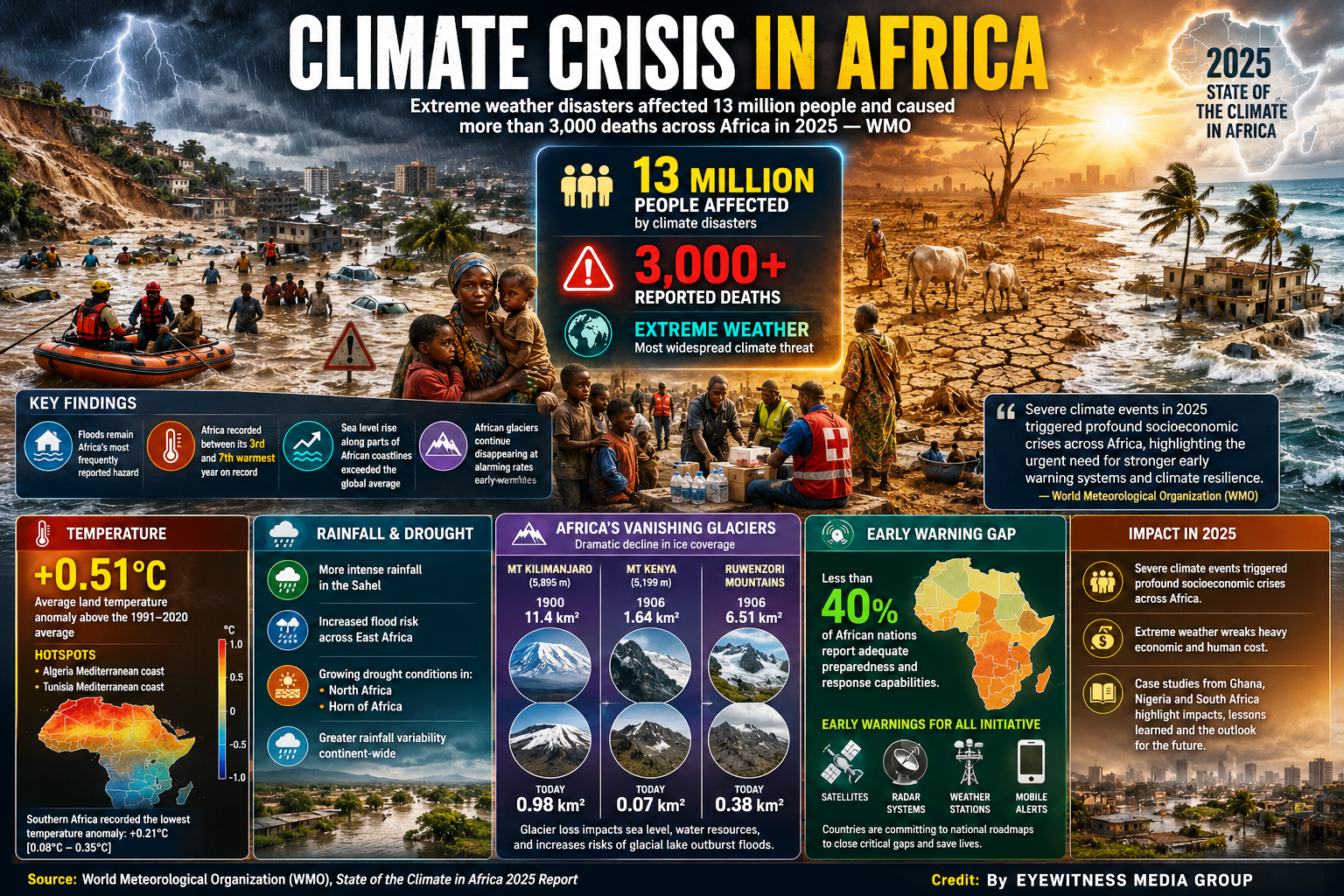
Extreme weather and climate-related events affected at least 13 million people and led to over 3,000 reported deaths in Africa in 2025, with knock-on effects across all sectors of the economy and society, according to a new report from the World Meteorological Organization (WMO).
The continent is struggling to cope with the impacts, and only 40% of countries have multi-hazard early warning systems which are needed to save lives and livelihoods.
However, there are encouraging signs that improved collaboration between meteorological services, disaster management agencies and local authorities, as well as advances in climate services like seasonal forecasts, is strengthening preparedness and response capabilities.
The State of the Climate in Africa 2025 provides a consolidated regional assessment, with authoritative information on key climate indicators, impacts and risks to support decision-making. It includes input from dozens of experts, National Meteorological and Hydrological Services, climate centres and United Nations partners.
The African continent is warming faster than the global average, and the rate of warming across the continent since 1991 is substantially higher than in any of the previous 30-year periods. The annual mean surface air temperature averaged over land areas in 2025 ranked between the third and seventh warmest on record, depending on the dataset used, according to the report.
Africa’s glaciers have lost more than 90% of their area since the late nineteenth century. On Mt. Kilimanjaro, glacier area has declined from 11.4 km² in 1900 to less than 1 km² in recent years.
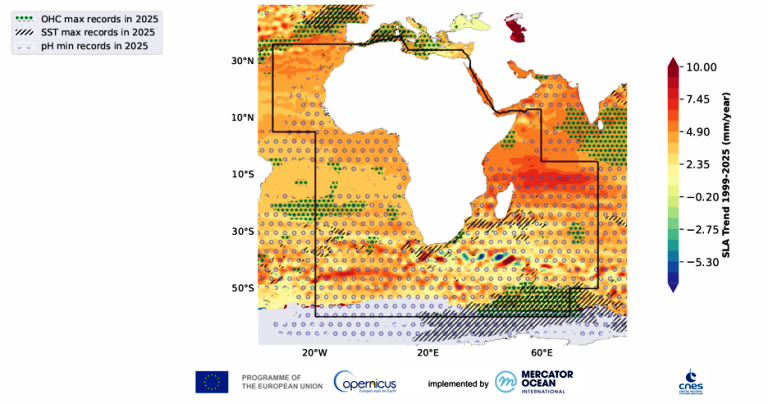
Ocean warming continues across the region, with widespread marine heatwaves. In 2025 ocean heat content and sea-surface temperature were lower than the record levels observed in 2023 and 2024 but remains in the range of historically high values from the past 10 years.
Ocean acidification is continuing, with record low surface pH observed across most of the region in 2025. Ocean heat and acidification harms marine ecosystems and livelihoods of people who depend on them.
Sea-level rise along African coasts from 1999 to 2025 exceeds the global average of 3.6 mm per year in several regions, reaching around 4.2 mm per year along the Atlantic coast, 5.2 mm per year along the Indian Ocean coast, and 5.6 mm per year in the Red Sea, according to the report.
INFOGRAPHIC/AEN.
Extreme weather is hitting the continent hard. Floods accounted for more than half of reported events – for instance severe flooding in Nigeria in May led to over 200 deaths, and flooding in the Democratic Republic of the Congo in April led to over 160 deaths.
The 2024/2025 tropical cyclone season was particularly active in the South Indian Ocean. Drought affected more than 8.5 million people in East Africa.
“The signs of a changing climate are clear across Africa – from increasing temperatures and rising seas to damaging floods and drought. This report shows not only the scale of the risks, but also the growing importance of early warnings, climate services and coordinated action to protect lives and livelihoods,” said WMO Secretary-General Celeste Saulo.
The annual mean surface air temperature averaged over land areas in 2025 in Africa ranked between the third and seventh warmest on record, at about 0.51 °C [uncertainty range: 0.31 °C to 0.60 °C] above the 1991–2020 average.
The highest temperature anomalies were recorded in North Africa, notably along the Mediterranean coast of Algeria and Tunisia. Southern Africa recorded the lowest temperature anomaly, +0.21 °C [0.08 °C–0.35 °C] relative to the same reference period.
Since the middle of the last century, rainfall trends in Africa have been mixed, with the dominant signal being a decrease in mean precipitation. The Sahel region had more intense rainfall throughout the rainy season during the period 1980–2010.
North Africa experienced an increase in aridity and in meteorological, hydrological and agricultural droughts (medium confidence), and recent observed drought extremes in the eastern Mediterranean Levant are without historical precedent within the recent multicentury period.
East Africa has experienced strong precipitation variability, with intense wet spells and floods in many countries, but also a significant decrease in rainfall in the Horn of Africa, especially during the long rainy season from March to May. In Southern Africa, heavy precipitation intensity and frequency have likely increased over the western and eastern parts of this sub-region.
GRAPGIC/WMO.
The year 2025 started and ended with a weak La Niña, which impacted precipitation patterns. In 2025, rainfall amounts for the Sahel region were above normal for the second consecutive year.
Above-normal annual precipitation totals were recorded in the majority of Southern Africa, although many of the East Africa islands received below-normal rainfall.
Most parts of East Africa received below-normal rainfall, both in the long and short rainfall seasons. Around the Horn of Africa, annual precipitation totals were unusually low.
In North Africa, annual precipitation totals along the coast to the Mediterranean Sea were below normal. Nevertheless, it was the first year that parts of north-western Africa received above-average precipitation after several years of below-average rainfall. The multi-year drought affecting North Africa, however, did not ease in all locations.
The melting of glaciers affects sea level, regional water cycles and the occurrence of local hazards such as glacial lake outburst floods. Currently, on the African continent, glaciers are limited to two volcanoes – Mt. Kenya in Kenya and Mt. Kilimanjaro in the United Republic of Tanzania – and the Ruwenzori mountain group on the border between Uganda and the Democratic Republic of Congo.
Mt. Kilimanjaro (5’895 m) is the highest mountain on the African continent and is home to Africa’s largest ice fields. Despite significant snowfall in 2025, its glaciers declined from 11.4 km² in 1900 to 0.98 km² in recent years.
Between 1906 and 2021/2022, the Mt. Kenya and Ruwenzori Mountains ice areas have shrunk from 1.64 km² to 0.07 km² and from 6.51 km² to just 0.38 km², respectively.
Severe climate events in 2025 triggered profound socioeconomic crises, emphasizing the necessity of targeted policy responses.
Throughout the African continent, there is growing commitment to the international Early Warnings for All initiative spearheaded by UN Secretary-General António Guterres. A number of countries have committed to national roadmaps, which unite different sectors of government and society.
The most recent report on the status of multi-hazard early warning systems (MHEWS) reveals that critical gaps remain, especially in Africa and least developed countries. Less than 40% of African countries report preparedness and response capabilities.
The State of the Climate in Africa 2025 report presents three case studies from Ghana, Nigeria and South Africa showcasing the impacts and risks, including lessons learned and the outlook for the future.