

INFOGRAPHIC/EMG.
By PATRICK MAYOYO
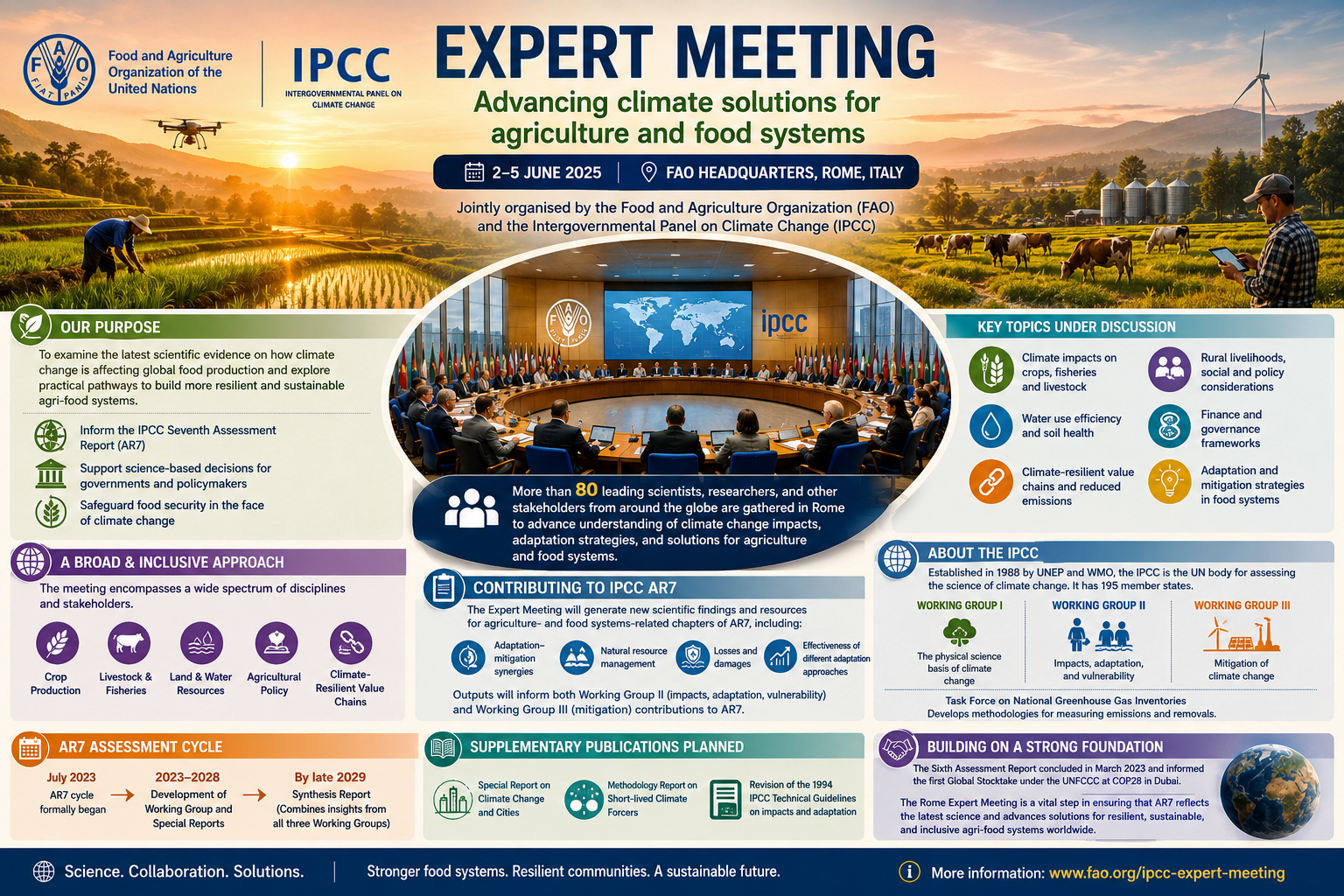
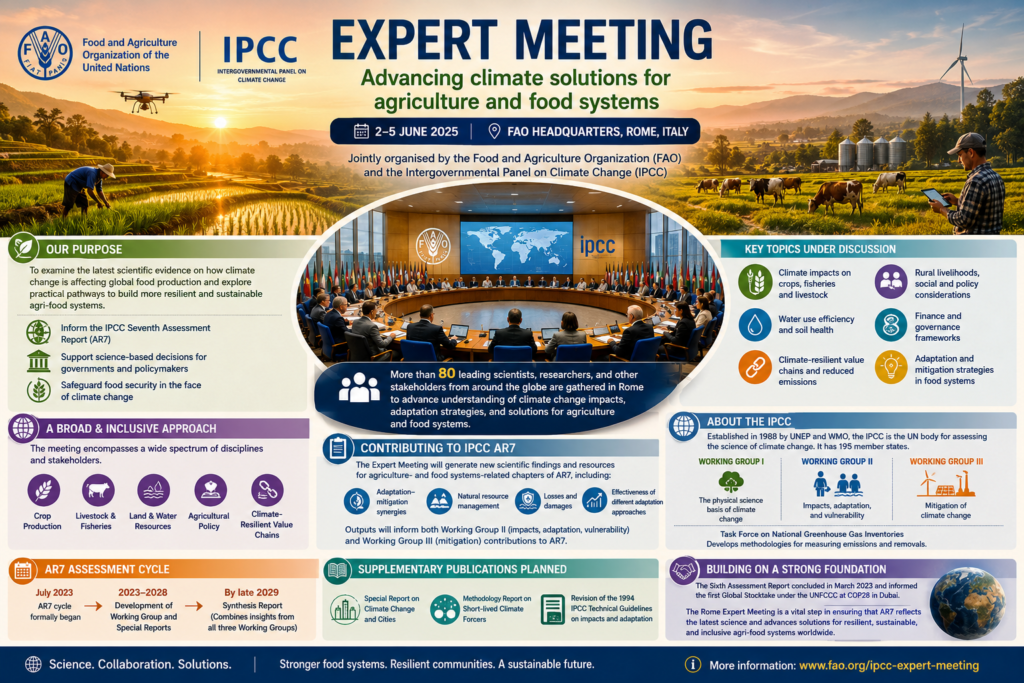
More than 80 leading scientists, researchers, and other stakeholders from around the globe have gathered in Rome this week for a pivotal international meeting aimed at advancing understanding of climate change impacts, adaptation strategies, and solutions for agriculture and food systems.
The four-day meeting, taking place from 2 to 5 June at the headquarters of the Food and Agriculture Organization (FAO), is jointly organised by the FAO and the Intergovernmental Panel on Climate Change (IPCC). Participants are examining the latest scientific evidence on how climate change is affecting global food production and exploring practical pathways to build more resilient and sustainable agri-food systems.
The gathering is a critical opportunity to bring together leading experts across all dimensions of food systems and the insights and recommendations produced will directly inform the IPCC’s Seventh Assessment Report (AR7) and, ultimately, support governments and policymakers in making science-based decisions to safeguard food security in the face of climate change.
The Expert Meeting encompasses a broad spectrum of disciplines, including crop production, livestock and fisheries management, land and water resources, climate-resilient value chains, and agricultural policy. Delegates will assess emerging risks across agricultural commodity chains and identify opportunities to strengthen both adaptation and mitigation strategies in food systems.
Among the topics under discussion are climate impacts on staple crops, fisheries, and livestock, strategies to enhance water use efficiency and soil health, and the design of climate-resilient value chains that reduce greenhouse gas emissions while supporting farmers’ livelihoods. Social and policy considerations, including rural livelihoods, finance, and governance frameworks, will also be central to the discussions.
The meeting is expected to generate new scientific findings and resources relevant to agriculture- and food systems-related chapters of the IPCC’s Seventh Assessment Report. These contributions will include insights into adaptation-mitigation synergies, natural resource management, losses and damages, and the effectiveness of different adaptation approaches.
Organisers emphasise that the outputs of this expert meeting will inform both the Working Group II and Working Group III contributions to AR7, which focus on impacts, adaptation, vulnerability, and mitigation of climate change.
The IPCC, established in 1988 by the United Nations Environmental Programme (UNEP) and the World Meteorological Organization (WMO), is the UN body responsible for assessing the scientific evidence related to climate change. Its mission is to provide political leaders and decision-makers with periodic, authoritative scientific assessments of climate change, its risks, and strategies for adaptation and mitigation. The Panel currently has 195 member states.
INFOGRAPHIC/FAO.
Several experts worldwide volunteer their time as IPCC authors, reviewing thousands of scientific papers each year to produce comprehensive, evidence-based assessments.
The IPCC’s work is divided among three working groups: Working Group I, which addresses the physical science basis of climate change; Working Group II, which focuses on impacts, adaptation, and vulnerability; and Working Group III, which deals with the mitigation of climate change. The IPCC also has a Task Force on National Greenhouse Gas Inventories that develops methodologies for measuring emissions and removals.
The assessments produced by the IPCC provide governments with scientifically robust information to guide climate policy and international negotiations. These reports are widely regarded as the most reliable scientific basis for climate action, and their development is characterised by multiple stages of drafting, review, and approval, ensuring transparency and objectivity.
The IPCC is currently in its seventh assessment cycle, which formally began in July 2023 with the election of new IPCC and Task Force Bureaus at its Plenary Session in Nairobi. During subsequent plenary sessions, the Panel has outlined the contributions of each Working Group to AR7.
Working Group I will address the physical science of climate change, Working Group II will focus on impacts, adaptation, and vulnerability, and Working Group III will cover mitigation strategies. The Synthesis Report, which combines insights from all three working groups, is scheduled for release by late 2029.
In addition to the main assessment reports, the IPCC has planned supplementary publications during AR7, including a Special Report on Climate Change and Cities, a Methodology Report on Short-lived Climate Forcers, and a revision of the 1994 IPCC Technical Guidelines on impacts and adaptation. These products aim to provide policymakers with practical guidance on specific topics critical to reducing climate risks.
The IPCC’s most recent assessment, the Sixth Assessment Report, concluded in March 2023 with the release of the Synthesis Report. This report fed directly into the first Global Stocktake process under the United Nations Framework Convention on Climate Change (UNFCCC) at COP28 in Dubai, offering policymakers an updated scientific basis for evaluating global progress on climate action.
The current Expert Meeting in Rome represents a vital step in ensuring that the agriculture and food systems components of AR7 are informed by the latest scientific evidence and practical insights. By bringing together leading experts, the FAO and IPCC aim to strengthen the integration of science into policy and promote solutions that enhance global food security while addressing climate change.
More information on this expert meeting is available here.