

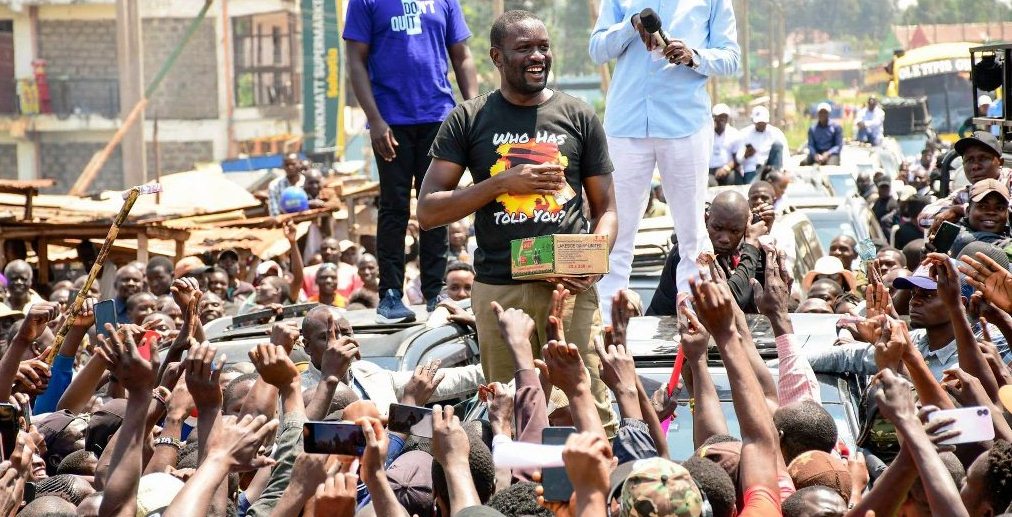
Senator Edwin Sifuna campaigning in Kakamega. PHOTO/UGC.
By PATRICK MAYOYO
Political history occasionally produces moments that fundamentally reshape expectations. Such moments are characterised not merely by the emergence of a new leader, but by a convergence of public mood, demographic change, political fatigue and an appetite for renewal.
Few elections in modern democratic history have captured the public imagination quite like the United States presidential election of 2008. The victory of Barack Obama, then a first-term United States Senator from Illinois, transformed assumptions about political leadership, party establishments and electoral possibility.
It demonstrated that even in one of the world’s oldest constitutional democracies, political history can change with remarkable speed when an unusual combination of leadership, organisation and public sentiment converges.
More than a decade later, the phrase “Obama Moment” has entered the vocabulary of political analysis far beyond the United States. It is frequently invoked whenever an emerging politician appears capable of challenging established elites, energising younger voters or reshaping the traditional rules of electoral competition. Yet the expression is often misunderstood.
An “Obama Moment” is not simply the rise of a charismatic politician. Nor does it describe every successful outsider campaign. Rather, it refers to a rare convergence of historical, demographic and political conditions that allows a candidate who initially appears unlikely to overcome more experienced rivals through organisation, message discipline, grassroots mobilisation and broad-based coalition building.
As Kenya’s political dynamics continues to evolve ahead of the 2027 General Election, some observers have begun asking whether Nairobi Senator Edwin Sifuna represents a similar phenomenon. The comparison does not suggest that Kenya and the United States are identical political environments, nor does it imply that history inevitably repeats itself.
Rather, it raises an interesting analytical question: can a relatively young, first-term senator emerge from outside the traditional hierarchy to become the principal challenger in a presidential contest?
The discussion has gathered momentum following major developments within the opposition. Following the death of ODM leader Raila Odinga, the party has reportedly experienced internal divisions, with two competing factions namely Linda Mwananchi led by Sifuna and Linda Ground led by new party leader Dr Oburu Oginga, seeking to shape its future direction.
Against that backdrop, Sifuna’s national profile has grown considerably through his public engagements, parliamentary interventions and political mobilisation.
Recent opinion polling has further fuelled debate. According to the scenario described, Sifuna has emerged as one of the country’s leading opposition politicians, with support levels placing him alongside more established presidential aspirants.
According to the latest TIFA opinion poll, the 44-year old lawyer is the most popular opposition leader in the country today, after he polled 15 percent against Jubilee Party’s presidential aspirant, Dr Fred Matiang’i’s 14 percent, Wiper Patriotic Front leader Kalonzo Musyoka’s 13 percent DCP leader Rigathi Gachagua’s 7 percent, President William Ruto’s 24 percent and 20 percent of undecided electorate.
While Kalonzo and Matiang’i have already declared their presidential ambitions, Sifuna says he is till consulting Kenyans through Linda Mwananchi rallies before making his presidential ambitions clear. Gachagua has also indicated that he could be in the presidential race if he is cleared by courts following his impeachment or if the due process in courts will not have come to an end by the time the 2027 polls are held.
Within ODM’s two splinter groups, the TIFA survey shows that Sifuna’s Linda Mwananchi camp enjoys 74 percent support among ODM supporters across the country compared to Dr Oginga’s Linda Ground’s 20 percent.
If Sifuna’s rising political wave continues to pick moment and opinion polls continue to show that he is the preferred opposition presidential candidate, will Kalonzo, Dr Matiang’i and Gachagua accept to rally behind him?
While opinion polls represent only a snapshot of public opinion and cannot predict election outcomes, they nevertheless influence political conversations by shaping perceptions of momentum and electability.
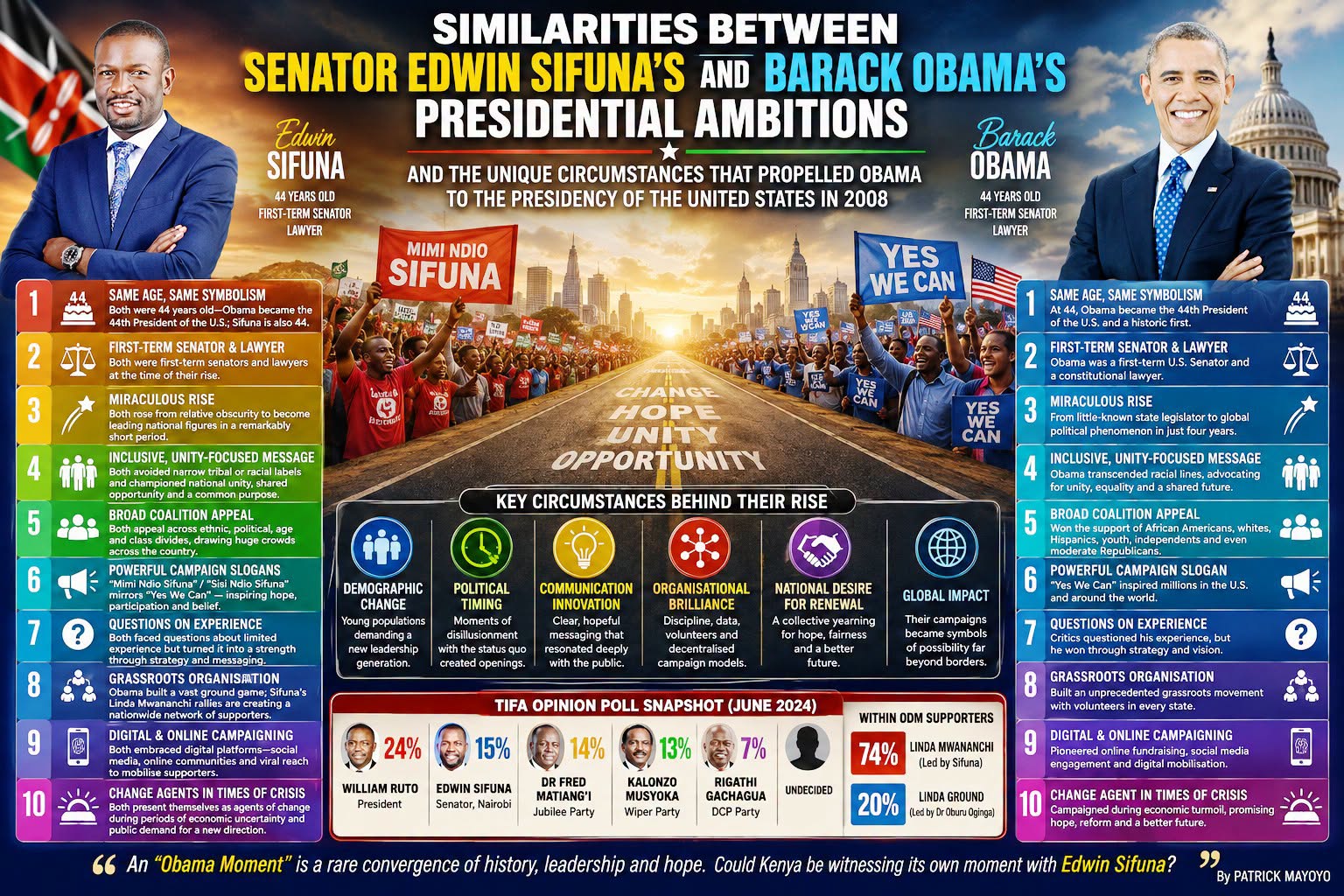
INFOGRAPHIC/EYEWITNESS MEDIA.
Whether that momentum can be sustained remains uncertain. Nevertheless, the emergence of a relatively young opposition politician has inevitably invited comparisons with Obama’s remarkable rise in American politics.
To appreciate the comparison, it is first necessary to understand why Obama’s election transformed political history. When Americans elected Obama as the 44th President in November 2008, they were not simply choosing a new administration. They were overturning decades of conventional political wisdom.
Only four years earlier, Obama had been a little-known Illinois state legislator beginning his first term in the United States Senate. Within an extraordinarily short period, he defeated some of the Democratic Party’s most established figures before going on to win the presidency as America’s first African-American Head of State.
His rise appeared extraordinary because it challenged deeply entrenched assumptions about political experience, race, party hierarchy and electoral viability.
Yet historians generally agree that Obama’s victory was not the result of a single factor. Instead, it reflected an unusual convergence of favourable political conditions, strategic organisation, compelling communication and changing demographics.
When Obama announced his presidential candidacy in 2007, many Democratic insiders considered the decision premature. The overwhelming favourite was Senator Hillary Rodham Clinton, wife former President Bill Clinton.
Clinton possessed almost every traditional advantage available to a presidential candidate. She enjoyed universal name recognition, extensive fundraising networks, overwhelming support among party leaders and the political infrastructure built during Bill Clinton’s presidency. Most political analysts regarded her nomination as almost inevitable.
The Democratic field also included experienced politicians such as Joe Biden, Christopher Dodd, Bill Richardson, Dennis Kucinich and John Edwards.
Joe Biden alone had spent more than three decades in the Senate and was widely respected for his foreign policy expertise. Measured solely by governmental experience, Obama appeared the least qualified among several leading contenders.
Instead of competing on experience, however, Obama fundamentally changed the terms of the debate. Rather than asking voters who possessed the longest political résumé, he asked them what kind of future they wanted after years of political division and unpopular wars.
His message of hope, unity and change resonated with voters seeking a different political direction. Perhaps Obama’s greatest innovation lay not in his speeches but in his organisation.
His campaign built an unprecedented volunteer movement that reached communities often neglected by traditional campaigns. Thousands of volunteers were trained to organise locally rather than waiting for instructions from national headquarters.
Equally revolutionary was the campaign’s use of digital technology. Long before social media became central to politics worldwide, Obama’s team recognised the internet’s capacity to mobilise volunteers, communicate directly with supporters and raise unprecedented sums through millions of relatively small donations.
Rather than relying exclusively on wealthy donors and established political networks, the campaign built a broad grassroots fundraising model that demonstrated both financial strength and popular enthusiasm.
This organisational model ultimately helped Obama overcome rivals who initially possessed greater institutional advantages. Another defining characteristic of Obama’s campaign was its ability to appeal across traditional political and demographic divisions.
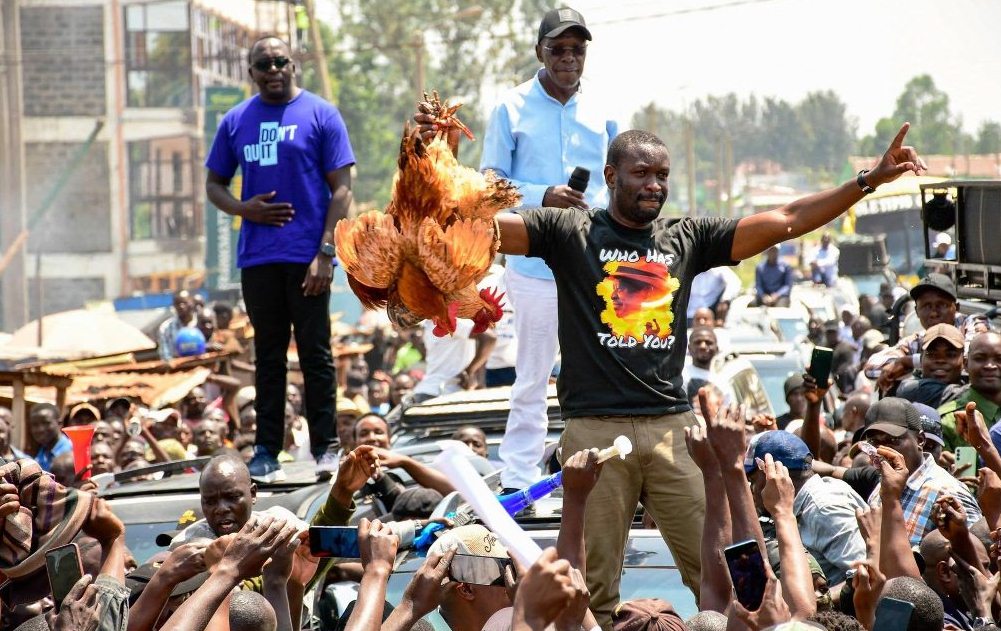
Kakamega residents donate chicken to Sifuna. PHOTO/UGC.
Although his election carried enormous significance for African-Americans, Obama consistently avoided presenting himself solely as a representative of Black America. Instead, he framed his campaign around national renewal.
His message attracted young voters, independents, urban professionals, minority communities and many moderate voters dissatisfied with the political status quo. This broad coalition proved decisive during the Democratic primaries before carrying into the general election.
It is against this historical background that some political commentators have drawn comparisons between Obama’s rise and Sifuna’s growing national visibility. Several similarities are immediately apparent.
Like Obama in 2008, Sifuna is a lawyer and a first-term senator who entered national politics at a relatively young age. Both politicians have developed reputations as articulate communicators capable of framing political debates beyond their immediate constituencies.
Supporters frequently portray Sifuna as representing generational change rather than simply continuity within existing political structures.
His public messaging has often emphasised constitutional governance, accountability, institutional integrity and democratic principles—issues that resonate particularly among sections of younger and urban voters.
Such themes inevitably invite comparisons with Obama’s emphasis on hope, institutional renewal and political reform. However, important distinctions must also be acknowledged.
Kenya’s political system, party structures, electoral dynamics and historical context differ substantially from those of the United States. Consequently, similarities in political style do not necessarily translate into similar electoral outcomes.
One of the strongest parallels lies in changing political demographics. Obama’s campaign successfully mobilised younger Americans who believed their generation should play a larger role in shaping national politics.
Similarly, Kenya possesses one of Africa’s youngest populations, with millions of first-time and relatively young voters expected to participate in the coming 2027 general election.
Young voters increasingly consume political information through digital platforms rather than traditional media. They often engage directly with political leaders through online discussions, live streaming and social media campaigns.
Politicians capable of communicating effectively within these spaces may enjoy advantages unavailable to previous generations of leaders. Whether that digital engagement ultimately converts into votes remains an open question, but it undoubtedly represents an increasingly important feature of modern elections.
Political campaigns frequently succeed because of compelling narratives rather than policy documents alone.
Obama’s “Yes We Can” political messaging became more than a campaign slogan; it evolved into a symbol of optimism and collective participation.
Similarly, Sifuna’s political branding of “Mimi Ndio Sifuna” has attracted considerable attention among his supporters, with most of them coining another version of this slogan “Sisi Ndio Sifuna” illustrating how memorable messaging can encourage public participation and create a sense of shared identity.
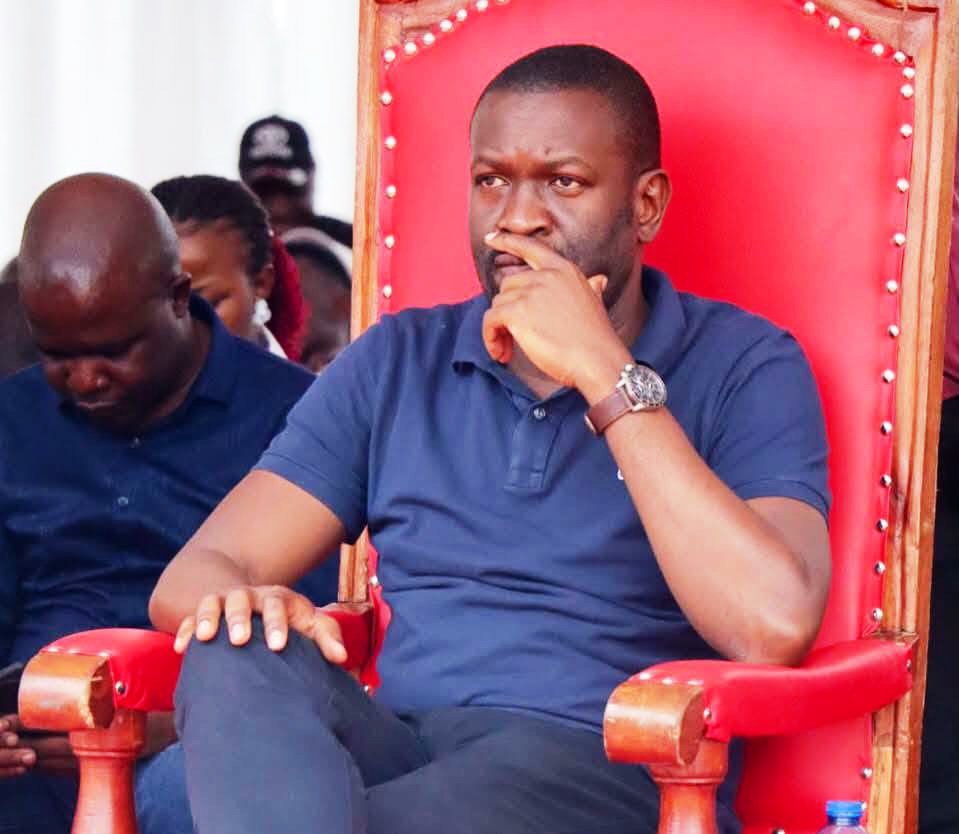
Sifuna thinking about the way forward. PHOTO/UGC.
Political communication scholars have long argued that successful slogans simplify complex political ideas into messages that ordinary citizens can easily remember and repeat.
Nevertheless, slogans alone rarely determine elections. They must be reinforced by organisational capacity, policy credibility and sustained public engagement.
Another comparison concerns grassroots organisation. Obama invested enormous resources in local volunteer networks, allowing supporters themselves to become campaign ambassadors within their communities.
Observers have similarly noted Sifuna’s emphasis on public rallies, community engagement and direct interaction with citizens. If such efforts continue expanding geographically and organisationally, they could strengthen his national political profile.
Yet grassroots mobilisation presents significant challenges. Maintaining volunteer enthusiasm over an extended campaign requires substantial resources, disciplined organisation and consistent messaging.
History demonstrates that early enthusiasm does not automatically translate into electoral victory. One criticism consistently directed at Obama concerned his limited experience. Opponents argued that the presidency required decades of executive and legislative service.
Obama responded by reframing experience as only one measure of leadership, arguing that judgement, vision and the ability to inspire collective action mattered equally. Comparable debates have surrounded numerous younger political leaders globally.
Whether voters ultimately prioritise experience or renewal often depends on prevailing national circumstances, including economic conditions, public confidence in existing leadership and perceptions of institutional performance.
The central question is not whether Sifuna is identical to Obama. Clearly, he is not. Every political leader emerges from distinct historical circumstances shaped by different institutions, cultures and electoral systems.
Rather, the more meaningful question is whether Kenya could experience a comparable political realignment in which an emerging politician overtakes more established politicians through a combination of effective communication, grassroots mobilisation and changing public sentiment.
History suggests such outcomes are possible. Political establishments have frequently been surprised by candidates initially dismissed as inexperienced or unlikely contenders. At the same time, many politicians who generated early excitement have ultimately failed to convert popularity into electoral success. Momentum is inherently fluid.
Opinion polls fluctuate, political alliances evolve, economic conditions change and unforeseen national events can rapidly transform electoral dynamics. Obama’s victory offers several enduring lessons relevant far beyond American politics.
First, organisation often proves as important as charisma. Second, broad coalitions generally outperform narrowly defined political constituencies. Third, technology has permanently transformed campaigning by enabling direct communication between politicians and voters.
Fourth, compelling narratives can reshape public expectations when they align with prevailing national sentiment. Finally, political history repeatedly demonstrates that assumptions about inevitability frequently prove mistaken.
Obama’s nomination was once considered improbable. By the end of 2008, it had become one of the defining political stories of the 21st century.
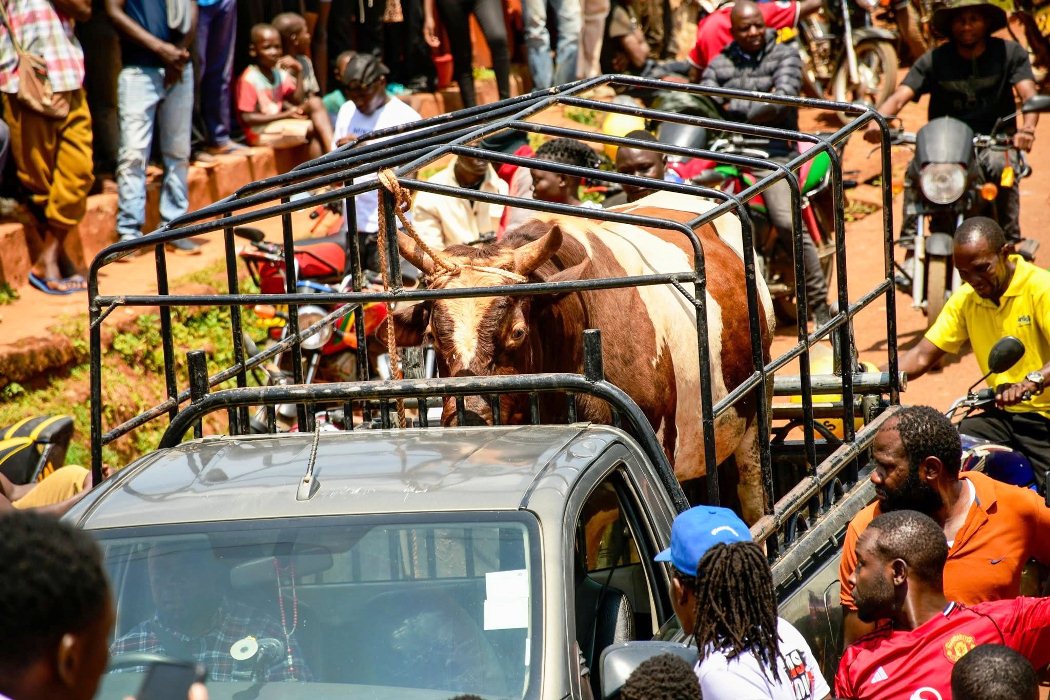
Kakamega Senator Dr Bonny Khalwale, donates a bull to Sifuna. PHOTO/UGC.
Whether Kenya ultimately experiences its own “Obama Moment” remains unpredictable to determine in at the moment, but history is always written by new emerging developments..
The analogy is useful because it encourages analysis of broader political forces rather than focusing solely on personalities. It invites consideration of how demographic change, digital communication, grassroots organisation, leadership style and public appetite for renewal can influence electoral politics.
Sifuna’s emergence as a prominent opposition leader has undoubtedly added a new dimension to Kenya’s evolving political landscape.
Equally, other opposition leaders continue to possess significant political experience, regional support bases and organisational structures that could shape the contest in different ways. President William Ruto, as the incumbent, would also enter any election with the advantages and challenges that accompany incumbency.
Ultimately, democratic elections are decided not by historical analogies but by voters, campaigns, coalitions, policies and events that unfold over time. The comparison Sifuna with Obama should therefore be understood as an analytical lens rather than a prediction.
Whether it develops into a genuine political realignment will depend on decisions made by political actors, the choices of the electorate and the broader national context as Kenya moves towards the 2027 General Election.
Successful political movements rarely depend upon a single factor. They emerge when leadership, organisation, timing and public sentiment reinforce one another. This broader understanding explains why commentators continue referring to “Obama Moments” in other democracies.
Comparative political analysis suggests that such moments become possible when several conditions converge. Citizens may become frustrated with established political elites. Younger voters may seek different forms of leadership.
New communication technologies may reduce the advantages traditionally enjoyed by established political organisations. Grassroots networks may become increasingly influential. Economic or institutional challenges may encourage demands for renewal.
Nevertheless, Political systems differ significantly. The United States elects its president through the Electoral College following extensive party primaries and caucuses. Kenya elects its president through a national popular vote subject to constitutional thresholds. Party organisation, campaign finance, coalition-building, constitutional arrangements and political history differ markedly between the two countries.
Similarly, the social cleavages that influence voting behaviour vary. Race occupies a distinctive place in American political history. Kenya’s politics have developed within different historical and social contexts, including regional, ethnic, constitutional and party dynamics.
Consequently, no foreign political model can simply be transplanted into another democracy. Political analysts therefore use the phrase “Obama Moment” not as a prediction but as a conceptual framework for understanding how political disruption sometimes occurs.
The enduring legacy of Obama’s 2008 campaign lies less in the uniqueness of one individual than in the demonstration that political systems are capable of renewal. His victory illustrated how organisation can compete with hierarchy, how grassroots participation can complement traditional party structures and how compelling political narratives can reshape public expectations.
Those lessons continue to influence campaigns around the world.
Whether similar moments emerge in Kenya depends not upon personalities alone but upon institutions, public opinion, economic conditions, campaign organisation and the choices made by millions of voters. Democratic politics remains dynamic precisely because no electoral outcome is predetermined.
In that sense, the “Obama Moment” is best understood not as the story of one election, but as a reminder that democracies occasionally produce transformative contests in which established assumptions are tested, unexpected coalitions emerge and political history takes an unforeseen direction.