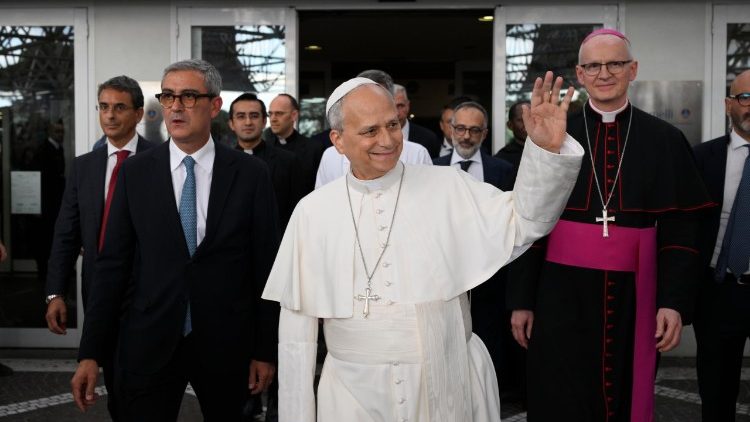


Pope Leo XIV waves to Catholic faithful as he leaves Gemelli Hospital. PHOTO/VATICAN.
By PATRICK MAYOYO
Catholics gathering for Sunday Mass across the world are invited to reflect on a powerful message about faith, political responsibility, love and humanity’s ultimate duty to God, as the readings of the day challenge believers to examine where their true allegiance lies.
At the heart of today’s Gospel, taken from Matthew 22:15–21, is Jesus Christ’s famous response to a politically charged question: “Then repay to Caesar what belongs to Caesar and to God what belongs to God.”
The exchange offers a lesson that reaches far beyond the tax dispute of biblical times, addressing the relationship between religion and government, the responsible exercise of authority, and the place of God in everyday life.
In the Gospel, the Pharisees and Herodians approach Jesus with a seemingly straightforward question: is it lawful to pay the census tax to the Roman emperor, Caesar?
Their intention is to trap him. Supporting the tax could alienate those who resented Roman occupation, while opposing it could expose him to accusations of rebellion against imperial authority.
Jesus, however, sees through their deception. Asking whose image appears on the tax coin, he receives the answer that it bears Caesar’s image. He then instructs them to give Caesar what belongs to Caesar and God what belongs to God.
In simple terms, Jesus recognises that people have legitimate civic responsibilities, including obeying just laws and fulfilling their obligations to society.
But he also makes clear that political authority does not possess unlimited control over human life or conscience.
The deeper message is that while money may bear the image of an earthly ruler, every human being bears the image of God. Consequently, no government, political leader or worldly power can claim the place that belongs to the Creator.
The Gospel therefore calls Christians to be responsible citizens without allowing politics, wealth, power or public opinion to replace their commitment to God.
The first reading, from Isaiah 45:1, 4–6, presents another striking message about authority and divine sovereignty.
God speaks of Cyrus, a Persian king (read Iranian King today) who would play a decisive role in the history of the Israelites, despite not knowing or worshipping the Lord as Israel did. God declares that he has chosen and strengthened Cyrus for the sake of his people.
The passage reminds believers that God’s purposes can be fulfilled through people and circumstances they might not expect. His authority extends beyond national borders, political systems and religious communities.
For today’s world, the reading challenges the assumption that God works only through familiar institutions or people who openly profess faith. It also warns political leaders against treating power as an entitlement. Authority, in the biblical understanding, ultimately remains accountable to God.
The central declaration, that the Lord alone is God, reinforces the Gospel’s message that earthly rulers have their place, but they are not sovereign over everything.
The second reading, from St Paul’s First Letter to the Thessalonians 1:1–5, shifts attention from political authority to the practical expression of Christian faith.
Paul, together with Silvanus and Timothy, praises the Thessalonian Christians for their work of faith, labour of love and endurance in hope through Jesus Christ.
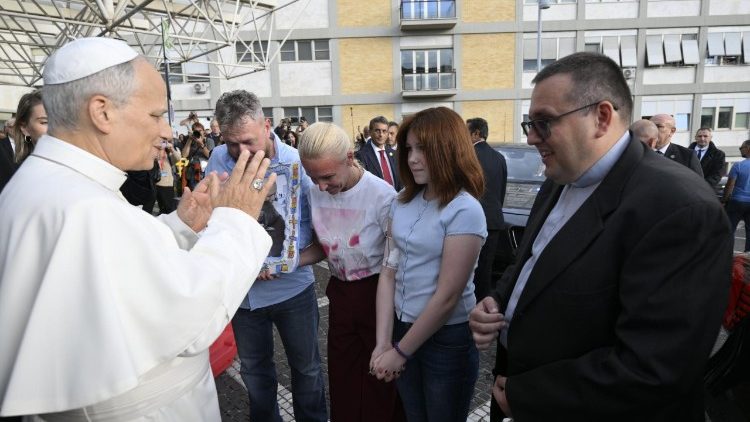
Pope Leo XIV greets young Ukrainian cancer survivor as he departs Agostino Gemelli University Hospital. PHOTO/VATICAN.
These are not merely religious expressions. They describe a faith that becomes visible through daily conduct: love that serves others, hope that perseveres during hardship, and conviction that remains firm when circumstances become difficult.
Paul also emphasises that the Gospel was proclaimed not through words alone, but through the power of the Holy Spirit and deep conviction.
For Catholics today, this is a reminder that faith cannot be measured solely by attendance at Mass, prayers or religious declarations. It must also be demonstrated through honesty, compassion, justice, generosity and perseverance.
Taken together, the three readings present a coherent message: God remains sovereign, human authority has limits, and genuine faith must transform the way people live.
Jesus does not tell his followers to abandon civic responsibilities. Rather, he challenges them to fulfil those responsibilities without surrendering their moral convictions or forgetting their obligations to God and their neighbours.
In societies facing political divisions, economic pressures, corruption and conflict, the Gospel invites believers to distinguish between what is legally required and what is morally right. Christians are called to contribute positively to society while remaining faithful to truth, human dignity and justice.
The message also speaks to personal priorities. If every person bears God’s image, then human dignity must be respected regardless of status, nationality, wealth or political affiliation.
Ultimately, today’s Mass asks a searching question: Are we giving God what belongs to him; our hearts, our choices, our love and our lives?
The answer, the readings suggest, is found not simply in what believers profess, but in how faithfully they live.
Meanwhile, Pope Leo XIV was discharged from Rome’s Agostino Gemelli University Hospital on Saturday afternoon following lung surgery earlier in the week.
The Holy See Press Office announced his discharge after doctors confirmed that his condition was stable enough for him to leave hospital.
Dr Luigi Carbone and Professor Stefano Margaritora said the Pope underwent blood tests and a chest X-ray on Saturday morning, with the results confirming that he was fit to be discharged.
Before leaving, the Holy Father thanked Professor Margaritora, who performed the operation, as well as the medical and nursing teams who cared for him during his hospital stay.
He also greeted healthcare staff, Professor Elena Beccalli, Rector of the Catholic University of the Sacred Heart, and the hospital’s leadership.
Before returning to the Vatican, Pope Leo celebrated Mass in a dedicated room on the hospital’s tenth floor.