


Marietta Kanini a castor beans farmer at her farm near Wote, Kenya. PHOTO/T&E/Gregory Onyango.
By SPECIAL CORRESPONDENT
- Eni’s new biofuel strategy involves the large-scale deployment of a new crop, castor, which the company promises is ‘drought-resistant’ and ‘does not compete with food production’ within African arid rural areas.
- In Kenya, the company is banking on the enrollment of thousands of small-scale farmers recruited by cooperatives, whose harvest is handled by multiple intermediaries. Meanwhile, in the Republic of Congo, the new program is being implemented by agribusiness companies which hold large land concessions.
-
In both countries, the company is struggling to meet its industrial development targets: only 24,5% of its 2023 production target has been achieved in Kenya, where two vegetable oil manufacturing plants are already operational.
- Eni has not moved beyond pilot stages in Congo and is yet to release the funds for the project, likely due to disappointing trial yields.
- Promoted as a new source of income for Kenyan small-scale farmers, castor farming has in reality been a source of disappointment for many of them, with their harvest particularly affected by drought, poor yields, and insufficient operational and technical support.
- Local farmers at two of Eni’s proposed sites in Congo allege that land they traditionally farmed was expropriated by the government in favour of the agribusinesses with whom Eni is now partnering.
-
In response to our questions, Eni denied that it had under-delivered on one of its flagship green projects and emphasised expected “improvements on agricultural yields” with the introduction of new plant varieties.
- Overall, Eni’s apparent failure to meet its ambitious agricultural production targets in Africa so far calls into question the viability of growing crops for biofuels at the scale required to make meaningful emission reductions in the transport and aviation sectors.
One of the biggest oil companies in the world and significant producer of climate change-causing fossil fuel emissions, Italian state-controlled supermajor Eni, has placed biofuels at the centre of its strategy to achieve net zero carbon emissions by 2050.
The company plans to become a global leader by 2035 in the production of so-called “sustainable fuels”. These use seed, nut and vegetable oils as the basis for fuel blends which,according to official estimates, emit between 60-90% less carbon dioxide than conventional fossil fuels, depending on the raw materials used.
The company says it will increase biofuel production fivefold by the middle of next decade, setting one of the most ambitious targets amongst its European peers.
Biofuels received a boost at the COP28 summit held in the United Arab Emirates in December last year, which called on countries to “accelerate” the use of “zero- and low-carbon fuels well before or by around mid-century”.
The Italian government is also promoting biofuels as a climate solution at both the EU and G7 levels, of which the country now owns the Presidency. It just released a grand strategic plan for a renewal in the African-Italian collaboration, named after Enrico Mattei, who gave birth to Eni; in which the new biofuels project plays a key role.
Eni’s strategy, which began taking shape in 2020, aims to produce a quarter of its biofuel from agricultural sources by 2026, the bulk of which will come from Africa where it has signed supply agreements with six countries.
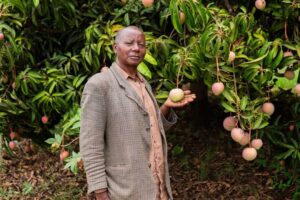
Benjamin Mbelenzi one of the castor beans farmers and his mangoes production in Makueni county, Kenya. PHOTO/T&E/Gregory Onyango.
Eni is building a network of agri-hubs across Africa to process vegetable oil from non-edible crops including the three “Cs” – castor, croton and cotton – as well as used cooking oil from restaurants and hotels.
Eni says that these crops, or feedstocks, are resistant to drought and suitable for planting on degraded soils, and will be grown by local farmers who will benefit economically.
Eni has labelled them “renewable raw materials” because, along with reused cooking oil, they are “not competing with the food chain”.
They are intended to replace traditional biofuel feedstocks, including palm oil, which Eni has relied on previously but which have long been shown to cause deforestation and worsen the climate, biodiversity and food crises.
Eni ships the processed vegetable oil thousands of kilometres back to Italy for conversion at its biorefineries, including into sustainable aviation fuel (SAF), a product the company plans to roll out in 2024 as global demand skyrockets. The company recently signed a deal with Ryanair for the supply of 100 000 tons of SAF between 2025 and 2030.
In a 70-page photo book Eni published in May 2022, titled “Seeds for Energy” the company highlighted Kenya and the Republic of Congo as two African countries where it is making the most headway with its biofuels strategy. They remain “the most advanced projects” in Eni’s bid to convert vegetable oil into biofuels, according to its website as at the publication date of this report.
In Kenya it has targeted tens of thousands of small-scale farmers as oil seed suppliers; whereas in Congo it plans to grow feedstock at scale on several huge tracts of land owned by multinational agribusinesses.
Transport & Environment (T&E) conducted field trips in both countries in the latter half of 2023 to assess the impact and viability of a project that not only forms a key part of Eni’s overall decarbonisation strategy, but which could act as a blueprint for the biofuels industry.
T&E interviewed farmers and other key political and business figures involved in the project to check whether Eni’s promises to communities and the environment were being met.
The investigation also gathered supply contracts and production data from project participants, and combed through Eni’s extensive public relations and investor disclosures, to assess whether the company is on track to meet its production targets.
We conclude that Eni is performing below – in some cases, well below – its lofty and ambitious goals.
Read the detailed story on T&E website here.